☕ Java Evolution: From Lambdas to Loom (8, 11 & 21)

Foreword
Java has long been a trusted language for building enterprise-grade applications. But if you’ve been stuck on Java 8 or just recently moved to Java 11, Java 21 might look like a leap into the future.
This blog is a developer-focused comparison of Java 8, Java 11, and Java 21 — the three Long-Term Support (LTS) versions that define modern Java development.
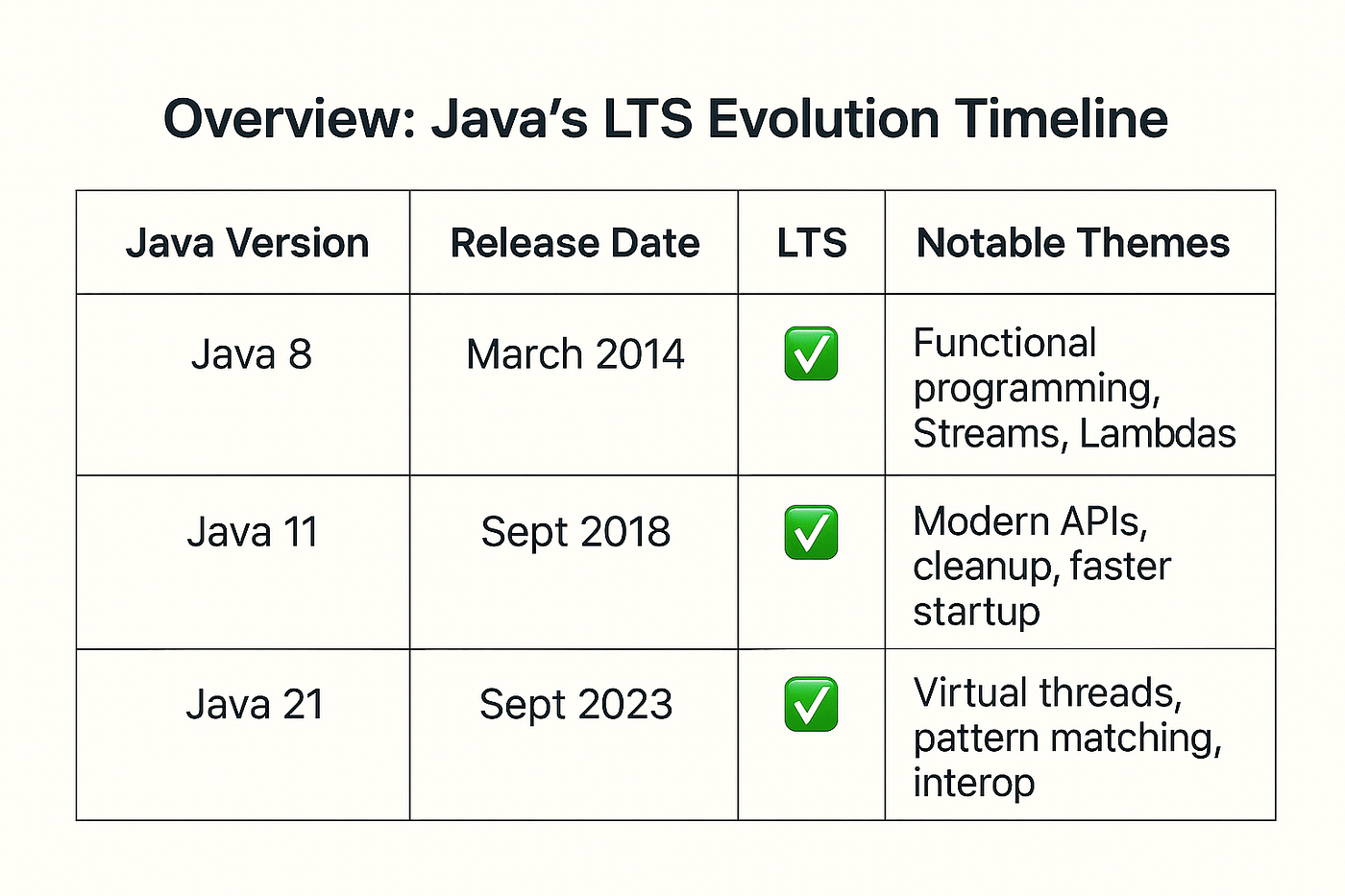
☕ Java 8: The Foundation of Modern Java
Java 8 introduced core language changes that revolutionized how developers write code.
🔑 Major Features
- Lambda Expressions — Functional programming on the JVM
list.forEach(item -> System.out.println(item));
2. Streams API — Declarative, parallel-friendly data processing
List<String> names = people.stream()
  .filter(p -> p.getAge() > 18)
  .map(Person::getName)
  .collect(Collectors.toList());
3. Default Methods in Interfaces — Enable evolution of APIs
interface Vehicle {
    default void start() { System.out.println("Starting..."); }
}
4. Optional — Eliminate null checks
Optional<String> name = Optional.ofNullable(input);
5. java.time API — A modern date/time library
LocalDate now = LocalDate.now();
✅ Strengths
Introduced Java to the modern functional paradigm.
Enabled cleaner, parallelizable code.
❌ Weaknesses
Lacked modern language ergonomics (pattern matching, improved switch).
Initial Stream implementation could feel verbose for advanced operations.
No built-in HTTP/2 support, native memory access, or lightweight concurrency.
🔄 Java 11: A New Baseline for Production
Java 11 solidified the shift toward modern cloud-native development.
🔑 Major Features
- New HTTP Client (Standardized from Java 9+)
HttpClient client = HttpClient.newHttpClient();
HttpRequest request = HttpRequest.newBuilder()
    .uri(URI.create("https://api.example.com"))
    .build();
2. String API Enhancements
isBlank(),lines(),strip(),repeat(n)
3. Local Variable Syntax in Lambdas
(var x, var y) -> x + y
4. Single-File Source Execution
java HelloWorld.java
5. Removed Legacy APIs
- JavaFX, CORBA, WebStart removed from the JDK
- Improved GC (G1 as default)
✅ Strengths
Better performance, startup time, and memory usage.
Cleaner API for HTTP and text processing.
Smaller JDK size and modularity (via Java 9’s module system, carried forward).
❌ Weaknesses
No major syntax improvements.
Still lacked a solution for writing highly concurrent code easily.
Native memory access was not ergonomic or safe.
🚀 Java 21: The Future is Now
Java 21 is the most exciting LTS release in a decade. With Project Loom, Panama, and Amber contributions, it finally brings features developers have been waiting for.
🔑 Major Features
- Virtual Threads (Stable) — From Project Loom
Thread.startVirtualThread(() -> handleRequest());
Thousands of lightweight threads with almost no memory overhead.
Same
ThreadAPI — no need to learn reactive programming to achieve concurrency.
2. Pattern Matching for switch (Stable)
switch (obj) {
    case String s -> System.out.println("A string: " + s);
    case Integer i -> System.out.println("An integer: " + i);
}
3. Record Patterns (Preview)
record Point(int x, int y) {}

if (obj instanceof Point(int x, int y)) {
    System.out.println("x = " + x + ", y = " + y);
}
4. String Templates (Preview)
String name = "Alice";
String message = STR."Hello \{name}, welcome!";
5. Scoped Values (Incubator)
- Better than
ThreadLocalfor sharing values across threads/virtual threads.
6. Sequenced Collections
SequencedSet,SequencedMap,SequencedCollectionprovide consistent order-first APIs.
7. Foreign Function & Memory API (Stable) — From Project Panama
Linker linker = Linker.nativeLinker();
- Safe and efficient access to native code — no JNI mess.
8. JEP Cleanup & JDK Enhancements
Better GC (ZGC and G1 improvements).
Classfile APIs, compiler updates, and performance boosts.
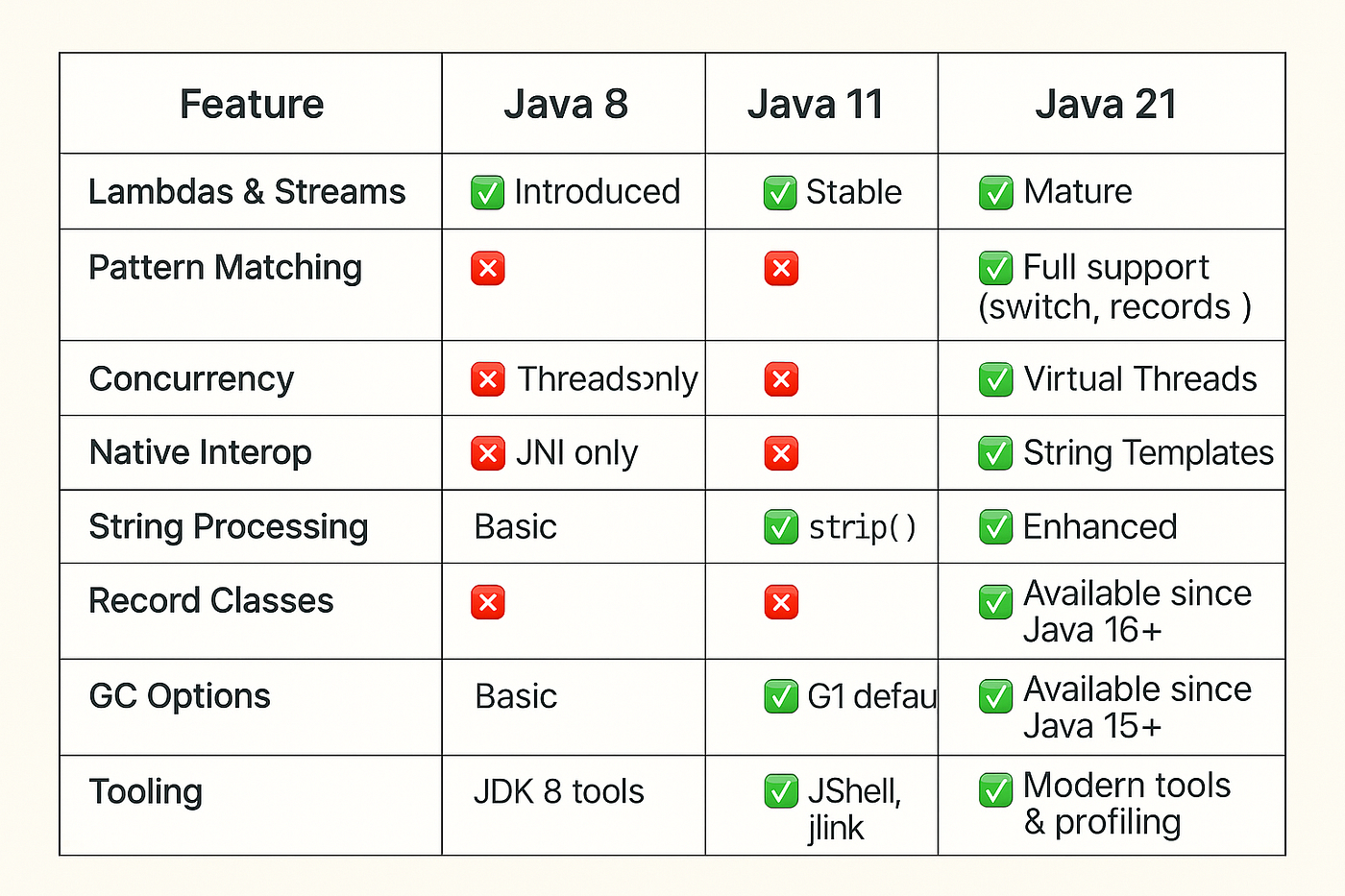
🧠 Detailed Comparison for Developers
💡 Should You Upgrade?
👨💻 For Developers:
Moving from Java 8 → 21 gives you better performance, cleaner syntax, and scalable concurrency.
From Java 11 → 21, you unlock modern syntax (pattern matching, record destructuring) and massive gains in concurrency with virtual threads.
🏢 For Teams:
Upgrading to Java 21 simplifies your architecture — say goodbye to frameworks like Project Reactor or Akka for simple concurrency use cases.
Cleaner codebase with modern language features makes onboarding easier and bugs fewer.
🔚 Final Thoughts
Java is no longer the verbose, conservative language of the past. With Java 21, it’s expressive, performant, and developer-friendly.
If you’re a Java developer or team still on Java 8 or 11, it’s time to rethink your stack. The language has evolved — and you should too.


