⚡ Supercharging LLMs with MCP

Preface
As Large Language Models (LLMs) become increasingly central to intelligent applications, one limitation becomes painfully obvious:
LLMs don’t know your context.
They can generate paragraphs of coherent language — but they have no idea what files you’ve opened, what meeting just ended, what code was recently deployed, or even what you just searched. This lack of context drastically limits how helpful they can be. Imagine a world where your AI assistant doesn’t just churn out clever responses but taps into live data, interacts with your favorite tools, and executes tasks like a seasoned pro. That’s the promise of the Model Context Protocol (MCP), a groundbreaking open standard launched by Anthropic in November 2024. MCP acts like a universal adapter, linking Large Language Models (LLMs) to external systems — think databases, APIs, or even your Google Drive — making AI smarter, more dynamic, and genuinely useful.
🔧 What is MCP?
The Model Context Protocol (MCP) is an open framework for integrating real-world context into LLM prompts — like files, code, calendars, and recent searches — allowing the model to generate smarter, more useful responses.
Picture it as the Wi-Fi of AI: a single, reliable way to link models like Claude or GPT-4 to real-world systems without messy, custom-built integrations. No more wrestling with APIs or hardcoding connections — MCP streamlines the process, enabling AI to fetch live data (like stock prices) or take actions (like posting to Slack).
Why does this matter? LLMs, for all their brilliance, are often stuck in a bubble, limited by their training data or the text you feed them. MCP bursts that bubble, giving AI the power to interact with the world in real time, making it more context-aware and action-oriented.
🏗️ MCP Architecture Overview
MCP acts as a bridge between user-facing apps and powerful LLMs, with a middleware that fetches, selects, and routes contextual data into the prompt stream.
Press enter or click to view image in full size
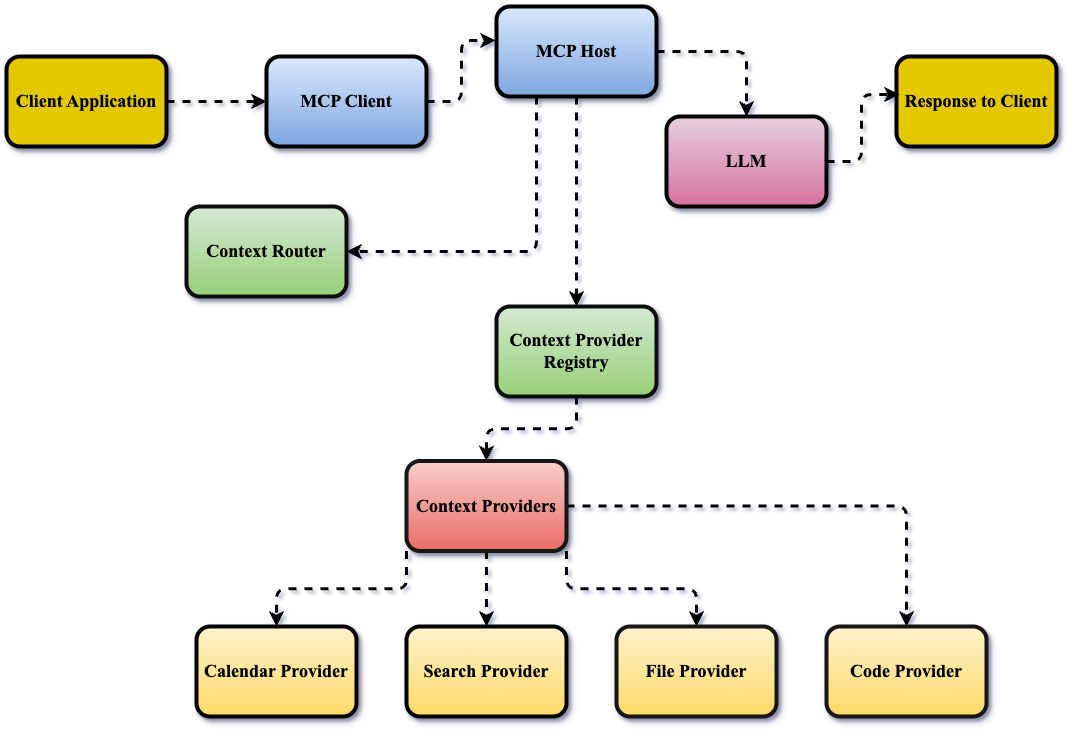
Here’s a breakdown of the architecture:
🔹 1. Client Application
The end-user interface (e.g., IDE, chat UI, browser extension). It forwards prompts to the MCP Client.
🔹 2. MCP Client
A lightweight client that sends the prompt and required metadata to the MCP Host.
🔹 3. MCP Host
The brain of the system, responsible for:
Identifying relevant Context Providers
Aggregating and formatting contextual data
Constructing a full prompt for the LLM
Subcomponents:
Context Router: Decides which providers are needed
Context Provider Registry: Tracks available plugins
Context Providers: Fetch real-world data
🔹 4. LLM (Large Language Model)
Consumes the enriched prompt and generates an intelligent response.
🔹 5. Response Flow
The LLM response is routed back to the client with optional metadata.
🔁 Data Flow in MCP
User prompt is sent from the Client to the MCP Client.
MCP Host identifies which context providers are relevant.
It collects and compiles data from each provider.
It sends an enriched prompt to the LLM.
The LLM processes it and returns a context-aware response.
🔌 Context Provider Examples
Let’s explore how various providers contribute contextual knowledge to enrich LLM understanding.
🗂️ File Provider
Purpose: Supplies local or remote documents, config files, or logs.
Example Use Case:
User asks: “Why is login failing?”
Context Returned:
{ "filename": "auth_service.py", "excerpt": "def login(user): if not user.is_verified(): raise AuthError" }
📅 Calendar Provider
Purpose: Brings in meeting history, deadlines, and schedules.
Example Use Case:
User asks: “When was the release discussed?”
Context Returned:
{ "title": "Sprint Planning", "time": "2025-05-22", "summary": "Discussed blockers and backend readiness" }
🧑💻 Code Provider
Purpose: Fetches recent commits, PRs, or code snippets.
Example Use Case:
User asks: “What changed in login recently?”
Context Returned:
{ "pull_request": "#452 Fix login for SSO users", "summary": "Added verification logic to login()" }
🔎 Search Provider
Purpose: Captures recent user queries or documentation lookups.
Example Use Case:
User asks: “How do I fix this error?”
Context Returned:
{ "query": "dropbox api upload python", "timestamp": "2025-05-25T10:17:00Z" }
🧠 Real-World Example
📝 User Prompt:
“Why is my login test failing after yesterday’s deploy?”
✅ Context Collected:
File Provider:
auth_service.pyshowing updatedlogin()logicCode Provider: PR that added a new
is_verified()checkCalendar Provider: Meeting notes from deployment on May 25
Search Provider: Query on “auth error after deploy”
💡 LLM Response:
“The login is failing because the
login()function was updated in the May 25 deployment to raise anAuthErrorfor unverified users. Your test user is unverified, which causes the failure.”
Real-World Use Cases
MCP’s versatility makes it applicable across industries and use cases. Here are a few examples:
Coding Assistants: An AI-powered IDE plugin uses MCP to fetch project-specific code from GitHub, suggest improvements, and commit changes, all within a single workflow.
Customer Support: An AI agent queries a CRM via MCP to retrieve customer order details, then sends a personalized response via Slack or email.
Research and Academia: Researchers connect LLMs to academic databases like PubMed using MCP to fetch and summarize relevant papers in real time.
Business Automation: An AI assistant manages workflows by pulling data from Google Drive, updating a database, and scheduling meetings via Microsoft Teams, all through MCP integrations.
Challenges and Considerations
While MCP is promising, it’s not without challenges:
Early Adoption Risks: As a new protocol, MCP lacks mature documentation and widespread support, which may pose a learning curve.
Scalability Concerns: High volumes of concurrent interactions may require performance optimization to maintain low latency.
Security Risks: Centralizing access through MCP introduces potential vulnerabilities, necessitating robust safeguards.
Model Dependency: MCP’s effectiveness depends on the LLM’s ability to handle dynamic context, which may vary across models.
Despite these challenges, MCP’s benefits outweigh its limitations, especially as the ecosystem matures and more developers contribute to its growth.
🚀 Final Thoughts
The Model Context Protocol (MCP) is a powerful new layer in the LLM stack. It transforms generic AI into true assistants that understand your environment, your work, and your goals.
If you’re building with LLMs, consider integrating MCP. It could be the difference between a chatbot and a genius.


